
Menu

Show posts

This section allows you to view all posts made by this member. Note that you can only see posts made in areas you currently have access to.

Show posts Menu

Messages - Mick

#1
The memcal modifications are real easy, and you do not even need to modify it if you use the UV erase method.
The stock eprom in the memcal is a UV erasable prom. Basically a device with a black light is used to erase the eprom in this scenario, and the entire memcal can be placed into most UV eraser devices.
A certain amount of time is required for the UV light to erase the eprom, after which the new code is burned with the eprom burner.

Although the UV eraser equipment is fairly inexpensive, many prefer to replace the existing eprom with an EEPROM (electrically erasable prom) such as the Atmel AT29C256. This permits direct reprograming so that only the eprom burner itself is required.
This also requires removal of the existing eprom, and I have found it quite easily done by cutting each of the legs with nail clippers.  Then apply heat to each remaining section of leg and pull out with some tweezers. This method is very fast, but a soldering iron with a very small sharp tip is extremely useful here.

Either way you choose, it is a very easy process, just more time consuming with the stock eprom, since it takes a bit of time to erase the eprom with UV light.

One very inexpensive part will make all the difference here. It is called a 34 pin wirewrap protected header, and it is modified slightly to create an adapter.  Here is a header before and after the slight modification :


This permits one to burn the eprom directly through the memcal (i.e. no eprom removal required). Here is what it looks like on the Pocket Programmer:
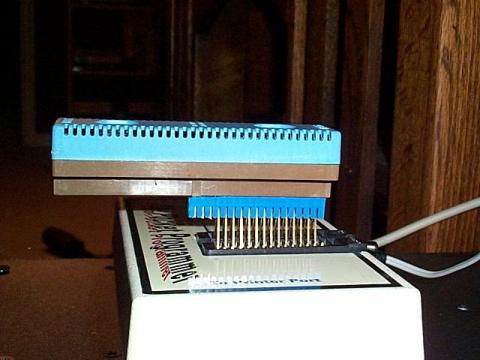


The 34 pin header can be purchased online, as can the UV eraser :

34-Pin Wire-wrap protected header
PN: CHW34G-ND
Price: $4.46
http://www.digikey.com/

DataRase II EPROM eraser
PN: 1022
Price: $46.95
http://www.thebytefactory.com
#2
GMPCM is best suited for windows laptop PC's, which you can have kicking around in your car for a while.  :)
It will run on all versions of Microsoft Windows developed after Windows 3.1 (i.e. requires a 32 bit windows operating system).  

So all you really need to do in this situation is install a 32 bit version of windows on your Mac, and GMPCM should run just fine after that.  
However, since installing 32 bit windows on a Mac would require that you replace the motherboard, processor, memory, keyboard, case, video system, and reformat your hard drive, it may not be the best option. :)
#3
Chip Tuning / 'ATMM' memcal
March 23, 2004, 10:17:48 PM
This is the info displayed for the ATMM binary in GMPCM's binary identification system :

ATMM5331

Note that it also indicates that the ATMM5331 code was superseded by the AUBL0073.  A supersede typically indicates changes made to address a TSB or other issue, so it would be best to use the AUBL0073 rather than the ATMM5331 if you have a choice.


Just a FYI.. there are over 6000 records in our searchable binary identification system, which basically covers any OBDI binary GM has ever used in its US applications. :)
#4
Chip Tuning / W/B 02
December 08, 2003, 10:28:45 AM
Actually, it?s even a bit complicated for me. :)

Here is how it works:

One would acquire a wide band oxygen sensor setup, either by purchasing one of the pre-made units or constructing their own.

Note:  The wide band signal is different then the normal band oxygen sensor that GM uses, so you would need to either install an extra bung for it, or use the "in tailpipe" approach.

The signal circuit from the wide band is pinned into the PCM at the connector plug, where on some applications it would replace the fuel pump voltage detection circuit, while others use an unused pin.  The correct pin for the specific code patch is indicated in the patch files description.

The code patch modifies areas of the binary that are typically not mapped in a definition. These areas are the "executable" portion of the code, also referred to as the algorithm section.  For example, some patches remap the TPS2 pin input into the "Desired Air Fuel Ratio" display after converting the signal from the raw 0-5 volts to a corresponding air fuel ratio value.  You can then read the wide band oxygen sensor as air fuel ratio directly at the "Desired Air Fuel Ratio" slot, using any scan tool or laptop ALDL scanning setup.

When you acquire a log or snapshot of the ALDL data, this data will now include the new WBO2's air fuel ratio value along with the usual RPM and MAP values. Since the data has a direct correlation, it can then be used to easily modify the corresponding "RPM vs. MAP" areas of the VE tables in order to obtain an optimal air fuel ratio at all operating conditions.

A primary area of interest will be the power enrichment fueling tables, as this is where the PCM reverts to open loop mode (i.e. does not use normal band O2 compensation to obtain a proper A/F ratio).

By setting the minimum temperature for closed loop operation to a value higher than that normally seen by the engine, one can also optimize the VE tables and parameters that the PCM uses to calculate A/F ratio during non-power enrichment operation quite easily.

Tuning using the above method is considered by many to be superior to the tuning capability one would typically obtain using a DYNO, as you can now address ?all? operating conditions at the exact load values encountered on the street, simply by driving around and collecting the ALDL data.

Collecting data at wide-open throttle can prove to be a challenge, if you live in a highly populated city. :)
#5
Chip Tuning / W/B 02
December 08, 2003, 12:43:52 AM
Seems like a lot of $$ to me when you can make your own for about half their asking price.  Not quite as feature packed, but then all you really need for tuning purposes is a WB signal output into the PCM.

If you have checked the GMPCM website recently, you may have noticed that the software now includes a code patching feature.  There are also several patch files available for download that modify code for wide band oxygen sensor input directly to the PCM, so that the WBO2 signal data can then be obtained from the ALDL scan stream as the "Desired Air Fuel Ratio" value.

A wide band O2 signal will be of optimal use in adjusting VE tables when the signal can be easily referenced to both RPM and load (MAP). These particular patch files provide this capability.

If this feature becomes popular, we will likely release a wider selection of WBO2 patch files that would include applications such as the 1227727 8F.  They are quite simple to use, as they only require a few mouse clicks to apply.

A patch export feature is also available that allows one to generate a new patch file from modified code with point and click ease. :)
#6
Chip Tuning / Just ordered a Programmer
December 01, 2003, 10:22:33 AM
Grab a set of nail clippers, may want to avoid using the wifes set tho.  :)
Clip the legs off the stock prom and then pull the remaining portion out with a bit of heat assistance.  Insert an Atmel AT29C256 electrically eraseable prom into the now empty socket, and apply a bit of solder to each connector from the sides..done. No more UV erase needed, decreases programming throughput time to a level surpased only by an emulator.

You can even purchase an AT29C256 chip direct from Xtronics now, for less than $7 :

http://xtronics.com/stock/surplus.htm#ICs
#7
Performance / Why is a BOV ( blow off Valve) so improtant
November 12, 2003, 01:42:34 AM
Jay :
Many of the conditions I have heard you describe could be an indication of either boost creep or surge.
What diameter exhaust are you running? With a cat or without? Any porting done to the exhaust side of the turbo?

One should optimally obtain max boost quickly, and this value should hold very steady.  If you overshoot the max specified (compressor surge), or if you are dropping from the max value without a corrsponding decrease in either load or rpm  (boost creep), then you may need to review the turbochargers flow charateristics, and possibly even make a few changes.

One or both of these situations can easily occur when increasing boost levels on a stock turbocharged system.
#8
Performance / Why is a BOV ( blow off Valve) so improtant
November 12, 2003, 01:17:25 AM
It does need to be very well sealed, however, when given the choice of doing so thru use of a gasket, or attempting to seal it with RTV, I would chose the gasket. :)

I mentioned the auto trans applicability, as I did not see any clarification of it on this thread.  We certainly would not want to encourage the stock transaxle (i.e. automatic) TGP owner's out there into needlessly buying and installing a BOV.
#9
Performance / Why is a BOV ( blow off Valve) so improtant
November 12, 2003, 12:54:41 AM
Well, that's not a good thing...  In its stock application on the turbo Eclipse/Talon's they DO use a gasket.

One could forego the use of a gasket with a very careful application of automotive grade RTV sealant.  However, if the small reference port is blocked by the sealant, the valve could be rendered inoperative.

The use of a BOV on an automatic trans equipped application offers very little performance benefit.  The throttle body plate that typically closes between shifts of a manual trans, does not close when an automatic shifts.

I used the GEN I BOV for my applications at one time.  I first purchased a slightly used one on ebay, but it produced a very obnoxious metalic squeak during valve operation.  Thinking it may have been defective, I decided to purchase a brand new one direct from Mitsubishi.. It had the same obnoxious squeak. :(
This probably has more to do with the fact that in a Fiero, you can hear just about any noise emitted from the engine bay, as the engine it is pretty much right behind and approx 1 ft. away from your ear.
#10
Performance / Question on Pistons....
November 09, 2003, 08:54:20 PM
I believe you could use the GEN III 3100 piston design if you desire to stick with a hyper rather than forged using the iron heads.

They offer an increased compressed height over the 3.1 MPFI piston, which results in a static compression ratio increase with aluminum heads from 8.9:1 to 9.6:1.
Pretty safe to assume that this 0.7 increase would also apply
when an iron head is used rather than the alum. head.

Using the 3.1 MPFI piston (either NA or TGP) with iron heads will result in a cr (< 7:1) which is really not advantageous for anything other than a high boosted strip application, since it would not be very steeetable due to the lack of off boost torque.
The 0.7 increase would not just make this a more feasible approach from a cr standpoint, the increased compressed height was employed when GM finally caught on to the fact that optimized piston quench was actually an important factor in engine design. :)
Thus, by using the GEN III piston design with iron heads, your quench height should also be close to optimized.

Optimized quench translates into a decreased detonation threshold, which allows one to obtain a marked increase in boost levels without the corresponding increase in fuel octane that would normally apply.